The anxiety is real: Will AI replace competitive analysts? Will automation make market researchers obsolete? The truth is far more empowering. AI-supported tools don’t replace your expertise in competitor analysis—they amplify it dramatically.
Traditional competitor analysis is time-consuming and often incomplete. You spend hours manually checking competitor websites, tracking pricing changes in spreadsheets, and piecing together fragmented information from multiple sources. By the time you finish your analysis, the competitive landscape has already shifted.
Modern tooling offers a different path. By combining automation, comprehensive data collection, and AI-powered analysis, these tools handle the heavy lifting of competitive intelligence. This frees you to focus on what humans do best: strategic thinking, contextual interpretation, and creating actionable competitive strategies.
The Amplification Principle: Modern Tooling as Your Strategic Partner
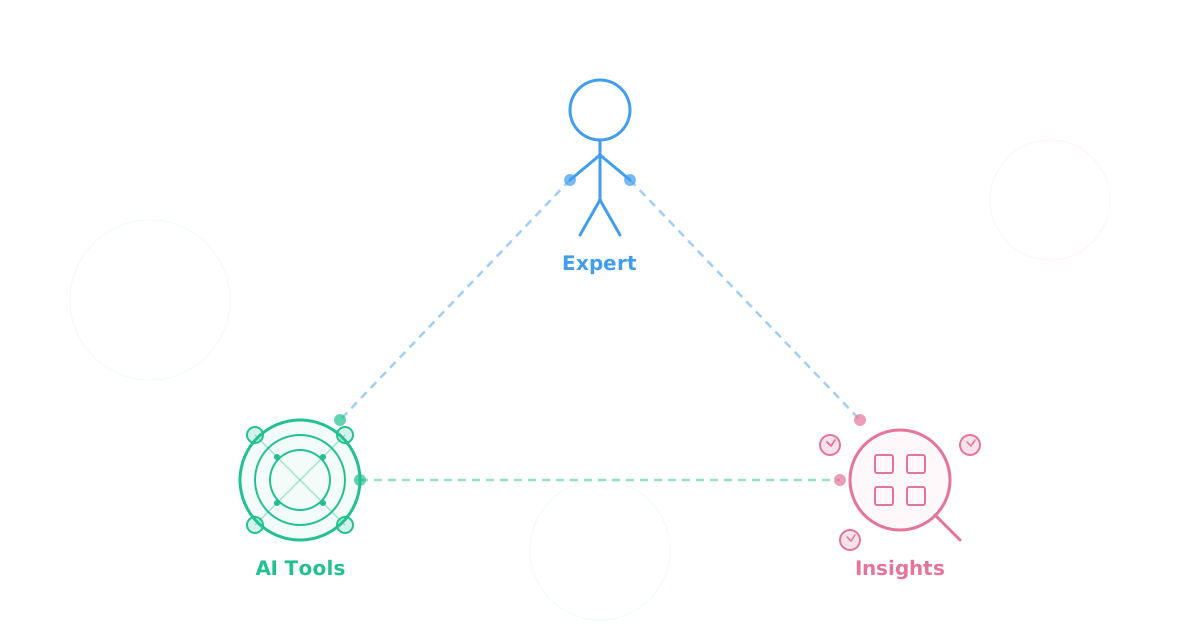
The most effective approach to competitor analysis in 2025 isn’t choosing between humans and AI—it’s understanding how they work together. Modern competitive intelligence combines AI capabilities with human strategic thinking , creating a partnership where each contributes their unique strengths.
The division of labor is clear: Tools handle data collection and processing. AI identifies patterns in massive datasets. Humans provide strategic interpretation, industry context, and decision-making. This isn’t about automation replacing jobs—it’s about augmentation amplifying expertise.
The technology stack that enables this amplification has four essential layers working together:
Automated Data Collection continuously gathers information from competitor websites, social media, news sources, pricing pages, and job postings—providing comprehensive coverage without manual effort.
Structured Data Organization takes collected information and organizes it for analysis, tracking changes over time and creating comparison views that make competitive landscapes visible at a glance.
AI-Powered Pattern Recognition analyzes organized data to identify patterns, trends, and anomalies. Research shows AI can spot subtle strategic signals across competitors—like detecting pivots from hiring patterns months before public announcements.
Human Strategic Interpretation applies industry context, identifies implications, creates strategies, and makes decisions. As competitive intelligence experts emphasize , tools provide intelligence but humans create competitive advantage.
According to research on competitive intelligence tools , 85% of businesses report better decision-making after adopting AI-powered competitor analysis tools. Companies using these tools are 2.5 times more likely to outperform their peers. The competitive advantage comes not from the tools alone, but from the human-tool partnership.
How Modern Tooling Transforms Your Workflow
Consider your current competitor analysis workflow. You probably spend significant time on data collection: checking competitor websites, reading their blog posts, monitoring social media, tracking pricing changes, and compiling everything into reports. This leaves limited time for the strategic work that creates competitive advantage.
Modern tooling flips this equation in three fundamental ways:
From Manual Checking to Continuous Monitoring
Traditional approach: Periodic website checks, quarterly competitive reviews, ad-hoc research when someone asks a question.
Modern tooling approach: Automated monitoring with intelligent alerts when changes matter—not weeks later during quarterly reviews, but when they happen.
Your amplified role: Responding strategically instead of hunting for information. What used to require days of research becomes hours of strategic thinking.
From Information Scarcity to Pattern Recognition
Traditional challenge: Missing competitor moves, incomplete picture, data scattered everywhere.
Modern tooling approach: Comprehensive data collection plus AI pattern detection across competitors. The system doesn’t just track individual changes—it identifies patterns that signal strategic shifts.
Your amplified role: Interpreting what patterns mean for your specific strategy. Harvard Business Review research shows AI can surface strategic signals from aggregate data that individual observations would miss.
From Reactive Analysis to Predictive Intelligence
Traditional limitation: Learning about competitor moves weeks or months after they happen, limiting your ability to respond effectively.
Modern tooling approach: Early indicators through automated tracking of patent filings, hiring patterns, supplier changes, and content shifts that predict future moves.
Your amplified role: Deciding how to respond proactively and positioning before competitors make moves public. You’re no longer constantly catching up—you’re staying ahead.
What Humans Uniquely Contribute
Understanding what tools do well clarifies where human expertise remains not just valuable but essential. These capabilities create competitive advantage:
Strategic Context and Industry Nuance: Tools collect data, but you understand what it means in your specific market. You interpret industry-specific jargon, recognize the difference between noise and meaningful strategic shifts, and understand competitive dynamics that don’t show up in data.
Identifying Emerging Threats: Automation focuses on known competitors. You spot emerging disruptors from adjacent markets that don’t fit existing categories. As intelligence experts note , identifying disruptors requires forward-looking thinking—connecting disparate information that AI might overlook.
Translating Intelligence into Action: Tools provide insights. You create strategies. This translation from intelligence to action is where competitive advantage actually gets built—developing responses, presenting findings with recommendations, and making judgment calls when data is ambiguous.
Asking Better Questions: Tools answer questions. You know which questions to ask. You refine what to monitor based on evolving business priorities, challenge assumptions, explore alternative scenarios, and guide the tools to gather intelligence that matters most.
Getting Started: Three Key Steps
Ready to amplify your competitor analysis? Start here:
1. Define What You Need to Amplify: Identify current bottlenecks in your competitor analysis process. Where do you spend time that doesn’t create strategic value? Map where you’re spending time versus where you’re creating value.
2. Choose Tools That Complement Your Expertise: Look for comprehensive platforms that combine automation, data collection, and AI. Prioritize tools that provide transparency into how they work—avoid “black box” solutions. The best tool is useless if it doesn’t fit how your team actually works.
3. Establish Human-Tool Collaboration Patterns: Set up monitoring for what matters most to your strategy. Create regular review cycles combining tool insights with team interpretation. Define when automated alerts require human strategic response.
Avoid These Common Pitfalls
Expecting AI Alone to Provide Answers: AI is one layer in the technology stack, not the complete solution. You also need robust automation and comprehensive data collection. The full stack—automation plus data plus AI plus human expertise—creates competitive advantage.
Treating Tools as a Complete Solution: Tools provide intelligence and insights, not strategy. The goal is amplification of your expertise, not abdication of responsibility. Best results come from tight human-tool collaboration.
Forgetting the Human Element: Don’t let tool-generated reports replace strategic discussion and debate. The richest insights come from teams discussing competitive intelligence together, challenging interpretations, and developing shared strategic understanding.
Conclusion
AI-supported tools amplify your competitive analysis expertise by handling data collection, pattern recognition, and continuous monitoring. This frees you to focus on strategic context, identifying emerging threats, translating intelligence into action, and asking the right questions.
The technology reality is clear: it’s the complete stack of automation, data collection, AI analysis, and human expertise working together that creates competitive advantage. Industry research shows 75% of companies will use AI-powered competitor analysis tools by 2025. Those who embrace the human-tool partnership will have significant advantages.
Start amplifying your competitor analysis today. Identify one repetitive task in your current process and explore how modern tooling could handle it, freeing you to focus on strategic work. Your expertise becomes exponentially more valuable when the right tools handle the heavy lifting.
Discover how Competition Compass combines automated data collection, AI-powered intelligence, and intuitive interfaces designed to amplify your competitive analysis expertise. The future of competitive intelligence isn’t human versus AI—it’s humans amplified by AI.